EDIT BLINDNESS
A quarter go unseen
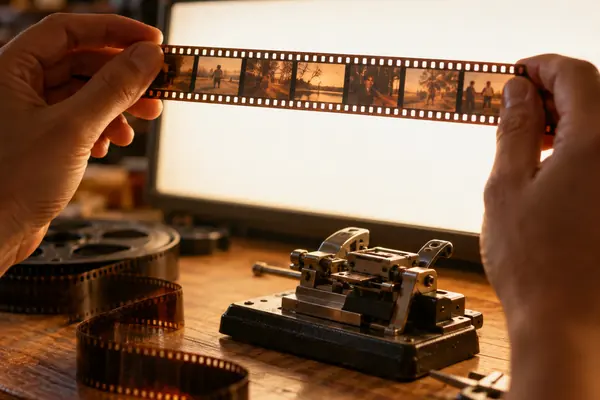
In a 2008 Edinburgh study, viewers asked to spot edits missed a quarter of cuts between two views of the same scene, and a third when the cut came with sudden movement.
Compare the cuts
WHAT THE RESEARCH SAYS
1 IN 4 same-scene cuts missed
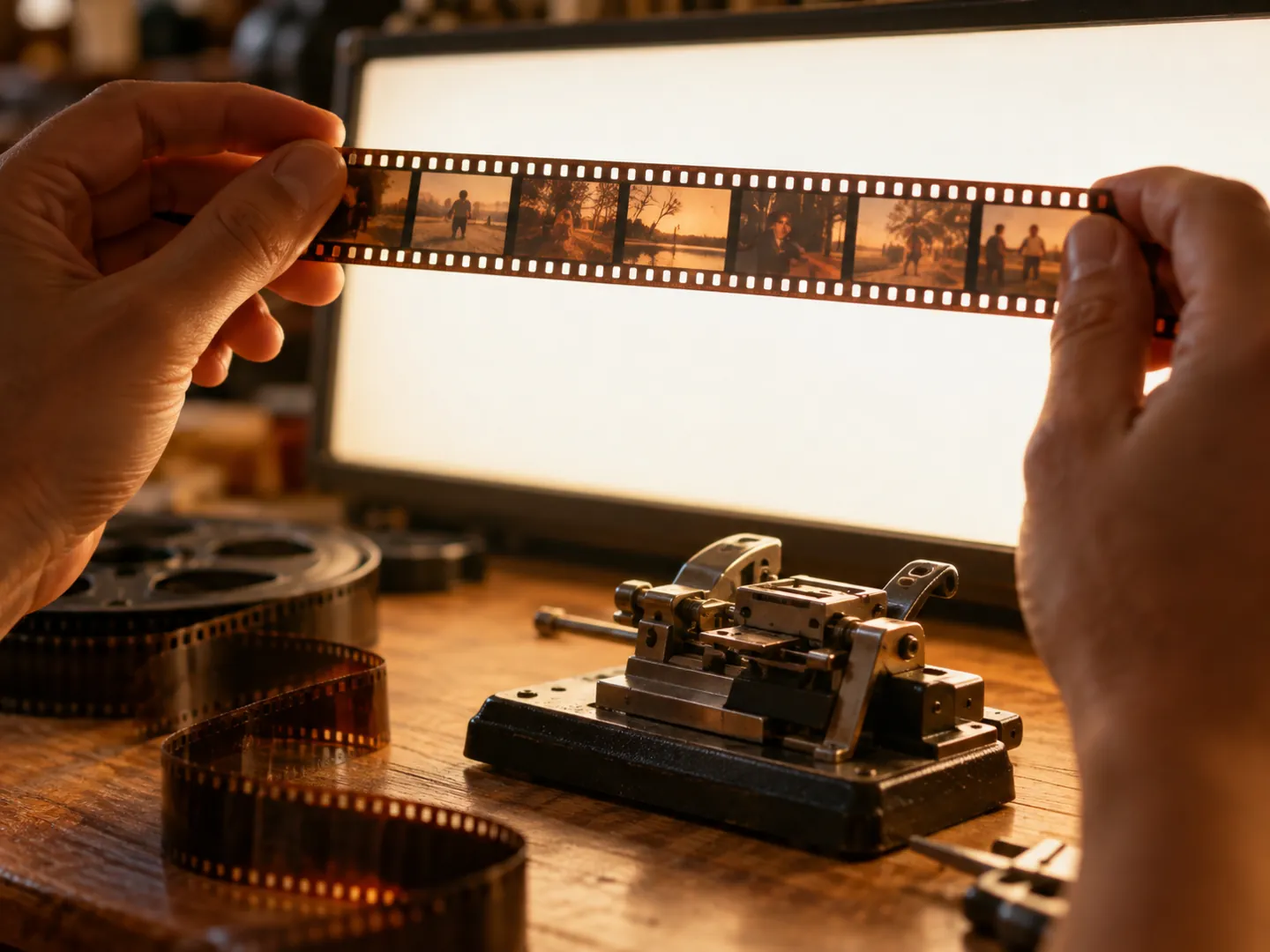
AI-generated image, not a photograph of a real person or place.
Every cut replaces the whole picture.
Film editing does this several times a minute, and most of the time we barely notice. Eye-tracking studies and measurements of hundreds of films show how editors keep it that way, and how the pace has quickened.
THE SHORT ANSWER
Some cuts land during a blink or an eye movement.
Most slip by because you are following the story.
EDIT BLINDNESS
In a 2008 Edinburgh study, viewers asked to spot edits missed a quarter of cuts between two views of the same scene, and a third when the cut came with sudden movement.
Compare the cutsPACE
Measuring 160 Hollywood films, Cornell researchers found average shots of about 10 seconds in the 1930s and 1940s, falling below 4 seconds after 2000.
See the numbersCLOSE-UPS
Across 31,000 shots in 24 films, close-ups were briefer than wider shots. In tests, people read a face's emotion faster when it filled more of the frame.
Try it yourself
FOUR THINGS TO TRY
You only need a film and a timer. Spotting cuts deliberately is harder than it sounds, which is exactly the point.
Tap the table at every cut in one minute of a recent film, then try a film from the 1940s.
Divide the seconds you watched by the number of shots. That is the average shot length researchers measure.
Watch for a door opening or a glass being lifted: editors often cut in the middle of the movement.
Researchers report that cuts tend to pull viewers' eyes towards the middle of the screen. See if yours follow.
TWO NUMBERS WORTH KNOWING
One figure on pace,
one on how shots are joined.
10 → <4 sec
Typical shot, 1930s and 1940s vs after 2000
From 160 English-language films released 1935 to 2010. The Seven Year Itch (1955) had the longest average shot at 26.2 seconds and Rocky IV (1985) the shortest at 2.2.
AVERAGE SHOT LENGTH · CORNELL
≈ 99%
Share of shot transitions that are straight cuts since the 1970s
Early films used cuts, dissolves and fades to mark shots, scenes and larger sections. The researchers say dissolves and fades turned out to be largely unnecessary.
TRANSITIONS · CORNELL
The same team found that contemporary films also contain more motion and are darker on average than films from the 1930s, and argue that all these trends help filmmakers steer viewers' attention.
WHICH CUTS SLIP BY?
Choose a type of cut to see how often viewers missed it when they were trying to spot every edit. The bar shows how easily that cut hides.
Based on Smith and Henderson (2008), Journal of Eye Movement Research. Viewers watched clips from feature films and were asked to detect every edit while their eye movements were recorded.
A RHYTHM IN THE CUTS
In a 2010 study of 150 popular films from 1935 to 2005, James Cutting's Cornell team found that shot lengths increasingly follow a 1/f pattern, the same kind of fluctuation found in human attention, heartbeats and tides.
Of their sample, Back to the Future (1985) came closest to a perfect 1/f profile. The pattern had no relationship with how much people liked the films on the Internet Movie Database, so it says nothing about quality, only about holding attention.
In conversation
A cut is an instant change from one shot to the next. Cornell researchers report that since the 1970s almost 99% of transitions between shots in popular films have been cuts rather than dissolves or fades.
Smith and Henderson found that a few missed cuts coincided with blinks or eye movements, but most seemed to be missed because viewers were attending to the story. Cuts that follow the continuity editing rules were missed more often.
Yes. In 160 films from 1935 to 2010, average shot lengths fell from about 10 seconds in the 1930s and 1940s to below 4 seconds after 2000, a trend that held across all five genres studied.
A Cornell study found that people read emotions faster when a face is larger in the frame and when there is less clutter around it. Across 24 films, closer shots were briefer.
It is a cut made in the middle of a movement, so the action carries across from one shot to the next. In Smith and Henderson's study it was the type of cut viewers missed most, at 32.4%.
Each figure on this page comes from the sources below.
ABOUT THIS NAME
doodlecuts.com is part of the DoodleSale portfolio. It isn't in an auction right now, but you can ask about leasing it.